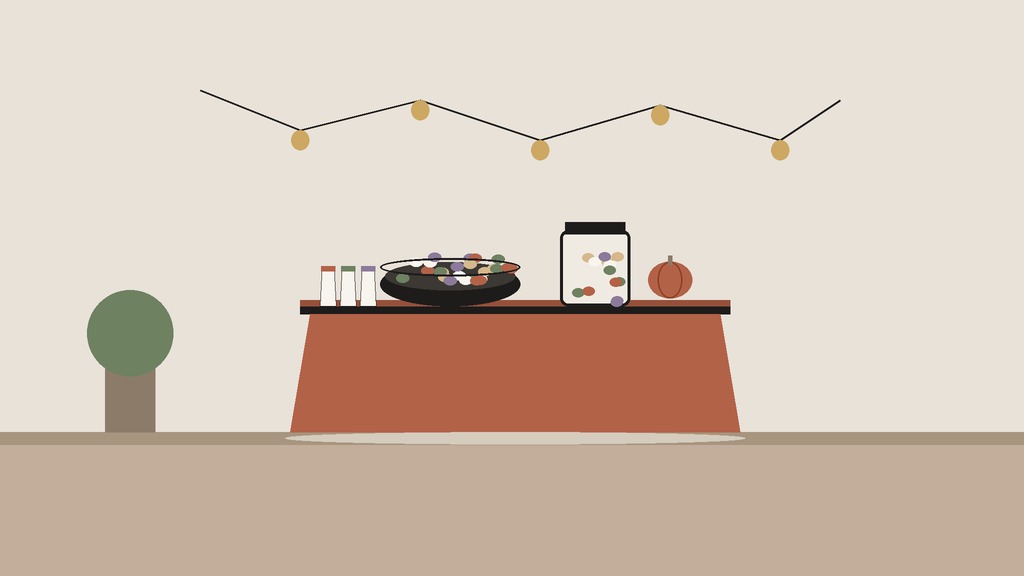
Trick-or-treat night comes down to a surprisingly small question: where does the candy go, and how do you get it into kids’ hands without a stampede? In a quiet cul-de-sac, a bowl on a stool will do. On a busy street with two hundred visitors, you will want something with a system.
Here are candy station ideas for both: a simple bowl that takes five minutes, and a full setup that makes the night smoother, safer and a little more fun for you.
First, estimate your numbers
Everything else follows from how many kids you expect. If this is not your first year, think back to last Halloween. If it is your first, ask a neighbour with a similar house.
- Quiet street, 10 to 20 visitors: one bowl and a small reserve.
- Moderate street, 30 to 60 visitors: a station with a table and a refill bin.
- Busy street, 100 or more: a system with grab bags or a two-person handoff.
A simple way to buy: count the kids you expect, multiply by two pieces each, then add about ten percent. Buying for the best-case crowd leaves you with a month of candy in the cupboard. Buying for the likely crowd and keeping a backup plan (a small extra bag, or frozen pizza for the household) is calmer.
The Less version: one bowl, one spot
The simple bowl is a good approach, not a lazy one. It works because there is almost nothing to go wrong.
- A wide, sturdy bowl or pail, wide enough that small hands do not spill it.
- A stool or small table on the step or just inside the open door.
- A light that hits the bowl and the face of the person holding it, so kids can see the treats and you can see the kids.
- A reserve bag just inside the door, out of sight. Refill the bowl every 20 minutes so you are not scooping from the bottom.
Set the bowl by 5:30 and you are done. If you are on the ground floor, you can answer the door and chat, and the bowl stays as a backup when you are busy. If you will be stepping away from the door, a small “Please take one” sign helps the bowl last past 6:45.
The More version: a full candy station
If you love the event, you can turn the front step into a destination. This is the setup for a street with a lot of traffic or a host who wants to stay outside and enjoy it.
- A table with a cloth, set back a metre or two from the step so a line can form without crowding the door.
- Pre-bagged treats. Spend an hour the weekend before filling small paper bags with two or three pieces each. Handing out bags is quicker than letting every child dig in a bowl, and you can keep non-candy options and allergen-friendly choices in a separate, clearly marked bag.
- A theme. A “witch’s apothecary” with labelled jars, a “pumpkin patch” with treats nestled in mini pumpkins, or a “candy cauldron” with a simple black pot. Keep it to one idea.
- A flow. One person or one station per task: someone who greets, someone who hands out. Even a family of two can split these jobs.
- Warmth. Warm layers, boots, a chair and a thermos for the adult on duty. Keep any heater or open flame well away from costumes, decorations and the candy table. In many parts of Canada, you will be out in near-freezing air.
A word on allergies and fairness
A teal pumpkin on the step, or a small bowl of non-food items like stickers, pencils or glow bracelets, tells families that you have something for kids who cannot eat candy. Keep that bowl separate from the candy so there is no cross-contact, and put it where a child can choose it without asking.
Individually wrapped items are best. If you offer both full-size and fun-size candy, stick to one kind for the night so the line moves at the same speed.
Canadian weather and timing
Halloween falls on a Saturday this year, and in most of Canada the sun sets between roughly 5:30 and 6:15 p.m., depending on where you live. Most trick-or-treating runs from about 5:30 to 8:00 p.m., and it is often chilly or wet. A few small decisions help a lot:
- Put the bowl under cover if rain or wet snow is in the forecast, such as the porch or just inside the front door.
- Use a clear path. Shovel, sweep leaves and check the steps for ice or slippery pumpkin guts.
- Bring the pumpkins out only at dusk if raccoons and squirrels are active on your street.
- Keep your outdoor light on and turn it off at the end, when your supply is gone. That is the universal “we’re done” signal.
The clocks also go back the next morning, so the night after has a bonus hour.
If you live in an apartment or on a tricky step
Not every home has a front step with room for a table. A few workarounds keep the night easy:
- Townhouse or condo hallway: check your building’s rules, then use a small side table by your own door and a sign that says where to knock.
- Narrow or steep steps: set the station at the bottom of the stairs or at the end of the walkway so kids are not queuing on a slope in the dark.
- Door with a small porch: stand just inside with the door open and the bowl at your side, so the warmth stays in and kids still see you.
- Not home or not wanting visitors: a light off means no candy. If you want to participate without being at the door, a self-serve bowl with a “take two” sign works in some neighbourhoods, though a bowl left alone is often emptied by one child, so many people skip it.
What to do with leftovers
Leftover candy is the hidden cost of Halloween. Decide in advance so you are not making the call on November 1 with a sugar headache. Common choices: put one handful in a jar for the week and send the rest to work or to a food drive; freeze chocolate bars for baking; or have the kids choose a favourite dozen and trade the rest for a small treat or a family outing. The simplest rule is to buy slightly less than you think you need, which makes the problem smaller before it starts.
Less or More: candy station at a glance
| Less | More | |
|---|---|---|
| Best for | Quiet streets, apartments, busy evenings | Busy streets, hosts who love the night |
| Setup time | Five minutes | One to two hours (bagging the week before) |
| Equipment | Bowl, stool, light | Table, cloth, bags, lights, themed pieces |
| Cleanup | Two minutes | Twenty minutes |
| Watch out for | Running out early | Over-buying and over-building |
When to stop adding to the station
The stop rule for Less: one bowl, one light, one reserve bag. If you find yourself adding a banner, a second table and a playlist, you are building More, and that is fine, but decide on purpose.
The stop rule for More: every piece on the table has to make the line move faster or make the night better for a child. Decorations that do neither can go on the porch instead.
The payoff for More is a night you remember. Kids talk about the house with the glowing cauldron for years, and you spend the evening laughing instead of refilling a bowl.
Plan the night before it starts
Whichever you choose, write the plan down: when to set up, who is on door duty, where the reserve candy lives, and when you turn off the light. The Trick-or-Treat Night Prep Kit from Green Velvet is a printable with going-out prep for parents, a door candy planner and notes for the door bowl, which gives the candy side of the night a home on paper.
For more simple systems around the house, visit the Less or More? hub. If you are also thinking about what the front of the house looks like, see our minimalist Halloween decor ideas and the fall entryway ideas.
Free checklist: Less or More?
Not sure which lane fits your room or closet? Our free 2-page printable walks you through a one-hour room reset and a weekend closet sort, with a Less column, a More column and a stop rule for each. We will email it to you, free.


Leave a Reply