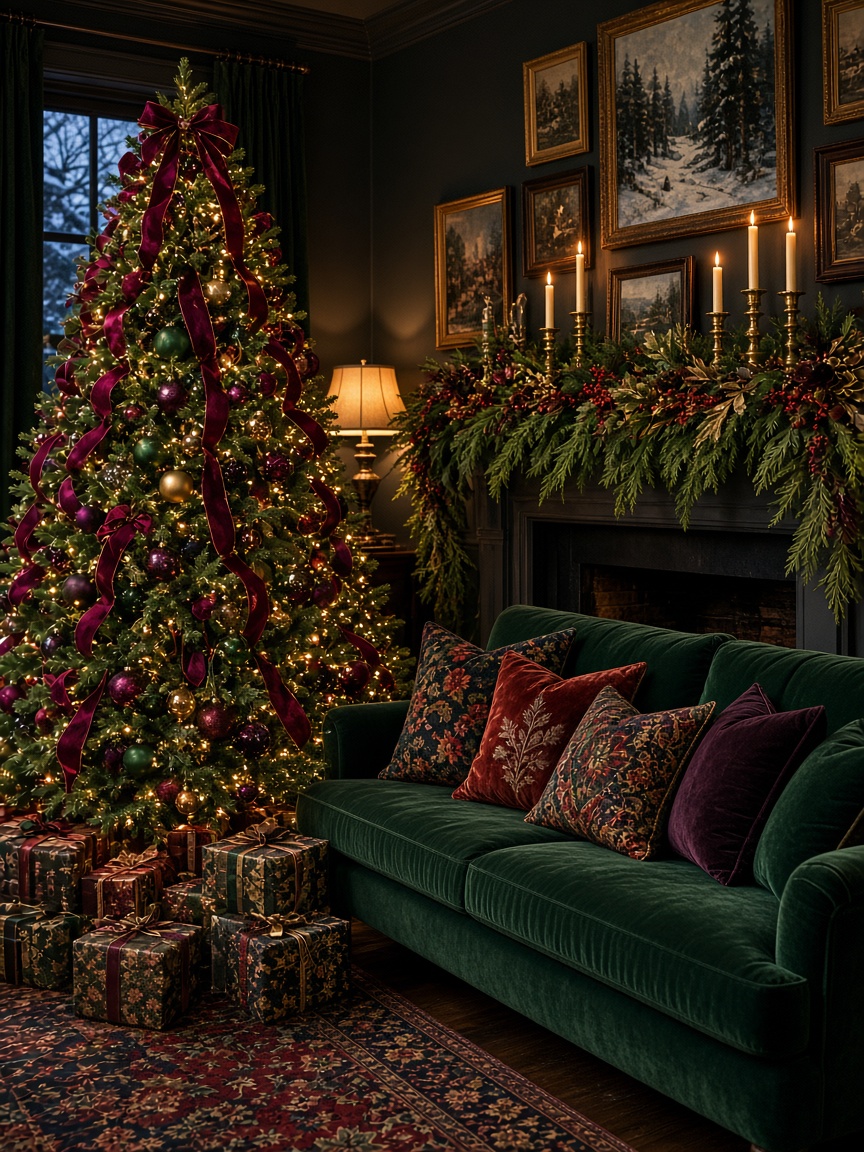
Maximalist Christmas decor has a reputation for being too much, and it is easy to see why. A tree in four colours, tartan on the sofa, a garland on every doorway and a table of ornaments can read as chaos. Done well, the same ingredients read as richness: a home that looks collected, joyful and deliberate. The difference comes down to three things, which are colour, pattern and layers, and each one has rules.
These rules are guardrails and not limits. Break any of them if the room looks better for it, but know which one you are breaking.
The Christmas Decor Planner from Green Velvet helps you pick a minimal or maximal look, plan each room, and list only what you still need.
Start with a palette, not a shopping list
A rich look needs a small, firm palette. The more varied the decor, the more important it is to limit the colours.
- Pick one dominant colour, such as deep green, burgundy or navy.
- Add one or two supporting colours, such as gold, cream or rust.
- Choose one accent, a small dose of something unexpected, such as pink, teal or violet.
- Choose a metal, gold, brass, copper or silver, and keep to it.
- Write the palette down. If an item is not in it, it stays in the shop.
Four palettes to borrow
- Forest and berry: deep green, burgundy, gold and cream.
- Midnight and brass: navy, teal, brass and ivory.
- Candy shop: red, pink, white and mint, with silver.
- Spice market: rust, olive, plum and gold.
If you used a fall palette this season, our guide to a fall colour palette for the living room shows how to balance rust, olive and plum, and the same logic carries into December.
Mix patterns with a method
Pattern is where maximalist decor can go wrong, so use a method.
- Pick a hero pattern: a plaid, a stripe, a floral or a damask.
- Add a medium pattern in a different scale, such as a stripe with a plaid.
- Add a small pattern or texture to fill the gaps, such as a fine check, a dot or a knit.
- Share a colour. Each pattern should include at least one colour from the palette, which ties the mix together.
- Mix types, not just sizes: a geometric with an organic, a woven with a printed.
- Rest the eye with a solid, such as a velvet pillow or a plain wall, between patterned areas.
Add texture
Texture is pattern’s quieter cousin, and it adds richness without noise.
- Velvet in ribbon, pillows and stocking cuffs.
- Wool and knit in throws and garlands.
- Metal and glass in ornaments and candle holders.
- Wood and natural fibre in baskets, trays and wreaths.
- Fur-like faux in a stocking or a throw, sparingly.
- Paper and card, such as stars and paper chains, for a handmade touch.
Build in layers, room by room
Layers carry the look from the focal point to the corners. Each room should have a focal point, a supporting group and a few small accents.
The living room
- Focal point: the tree. See our Christmas tree theme ideas for a five-layer method.
- Supporting group: the mantel or a shelf. See our Christmas mantel decor ideas.
- Accents: pillows, a throw, a bowl of ornaments on the coffee table.
The dining room
- Focal point: the table. See our Christmas table decor ideas.
- Supporting group: a sideboard with a garland and flameless candles.
- Accents: napkins, place cards and a wreath on the back of a chair.
The entry
- Focal point: a wreath and a lantern.
- Supporting group: a console with greenery and a few ornaments.
- Accents: a runner, a bowl for keys and a seasonal doormat.
The kitchen
- Focal point: a garland over the window or the open shelves.
- Accents: tea towels, a bowl of fruit and a small tree on the counter.
Bedrooms and bathrooms
Keep them gentler. A wreath, a small tree or a string of lights is enough, and the quiet gives the rest of the home room to be loud.
Use light as a layer
Warm light turns a busy room into a glowing one. Our guide to indoor Christmas lights covers how to layer light and how to check cords and timers. For candles, choose flameless ones near greenery, fabric and children, and follow safe habits with real flames: sturdy holders, a flat surface, nothing nearby that can burn, and snuff them before leaving the room.
Mix old, new and handmade
A collected look has a story in it.
- Inherited ornaments carry memories, and they look best grouped with a common colour behind them.
- Handmade pieces, such as paper stars, salt dough shapes or knitted stockings, add warmth. Keep food-based decorations away from pets.
- Thrifted finds, such as brass candlesticks or glass bowls, add age to a new palette. Clean them with a cleaner made for the material, following its label and testing a hidden spot first.
- New pieces fill gaps, and should match the palette.
- Children’s art looks good framed and hung in a cluster on a wall.
Repeat to unify
Repetition makes a busy home feel planned.
- Repeat a colour in every room.
- Repeat a motif, such as stars, birds or pinecones, on the tree, the table and the mantel.
- Repeat a material, such as brass or velvet.
- Repeat a shape, such as a round ornament in different sizes.
Edit with care
Maximalism is not accumulation. Edit as you go.
- Step back after each room, and look at it in the evening light.
- Remove one item that competes with the focal point.
- Check the paths, the doorways and the surfaces where people need space.
- Check the safety: cords, candles, breakables and anything that can fall.
- Leave some surfaces bare, so the eye can rest.
Safety for a full home
- Keep walkways clear of cords and decor.
- Follow the manufacturer’s instructions for the lights, power strips and timers.
- Keep decor away from heaters, fireplaces and candles.
- Choose unbreakable ornaments for the lower branches if you have children or pets, and keep small pieces away from children under four.
- Check plants and berries before placing them where pets can reach them, and ask your vet if you are unsure.
- Turn lights off when you leave the house or go to bed.
Shop your own boxes first
A maximalist home may already hold the ingredients.
- Take everything out of the boxes, and sort by colour.
- Group by palette, and set aside pieces that do not fit.
- Look for pieces that could be used in a new way: a basket as a tree skirt, a scarf as a runner.
- List the gaps, and buy only what is on the list.
- Release what you did not use or no longer love.
Spend where it shows
A full look does not need every item to be new.
- Put the effort into the focal points, such as the tree and the table, and keep the supporting pieces simple.
- Use ribbon and greenery to tie mismatched items together.
- Repeat what works. One good ornament in a large cluster beats many different ones.
- Set a total before you shop. Our guide to planning a holiday gift budget shows the method, and the same approach works for decor.
Plan it on paper
The Christmas Decor Planner: Minimal or Maximal from Green Velvet has a palette picker with three maximal palettes, a room by room plan, an own it list for taking inventory by box, a gap and budget list that says to buy only what is on the plan and a decorating timeline. It also includes a worked sample of a maximal plan.
Less or More: the maximal dial
| Less | More | |
|---|---|---|
| Palette | Two colours and a metal | A dominant colour, two supports, an accent and a metal |
| Patterns | One hero | Hero, medium and small |
| Rooms | Living room and table | Every room |
| Layers | Three | Five |
| Watch out for | Missing the glow | Losing the focal point |
Richness takes a plan
A full, joyful Christmas home is built, not scattered. Pick the palette, set the patterns, add the layers and edit. By the end, you should be able to say what the look is in one sentence. The Maximalism hub keeps the full and festive rooms together, and our guide to early Christmas decor ideas covers when to start.
Free checklist: Less or More?
Not sure which lane fits your room or closet? Our free 2-page printable walks you through a one-hour room reset and a weekend closet sort, with a Less column, a More column and a stop rule for each. We will email it to you, free.


Leave a Reply