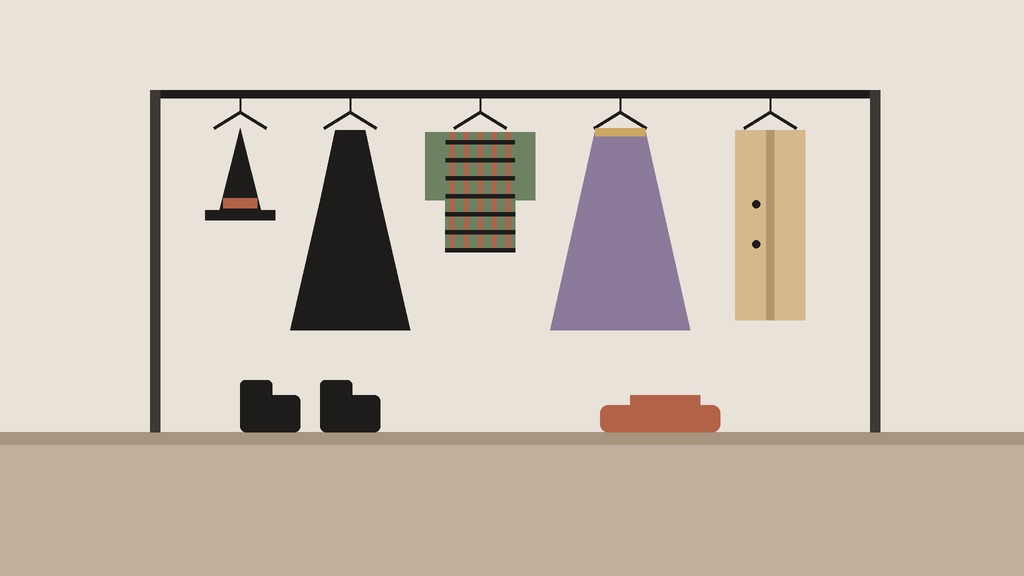
It is the last stretch before Halloween, the party invitation is on the fridge, and you have no costume. This is the most common Halloween problem there is, and the answer is almost always already in your closet. The trick is knowing which pieces to reach for and how far to take them.
Here is how to put together easy Halloween costumes from your closet for adults, in two ways: a Less version that takes ten minutes and one prop, and a More version for people who like to build a character. Both skip the packaged costume with a one-night shelf life.
Start with the pieces, not the idea
Most people begin with “What should I be?” and end up in a store. Flip it. Lay out what you own in four piles, then see what characters appear.
- All black: dresses, turtlenecks, jeans, tights, long coats, boots.
- Plaid, denim and flannel: shirts, jackets, work boots, bandanas.
- White and light: shirts, nightgowns, linen layers, long cardigans.
- Statement pieces: the sequin top, velvet blazer, faux fur, cape, hat or scarf you wear twice a year.
Whichever pile is biggest points to your costume. If it is black, you are halfway to a witch, a vampire, a bat or a cat. If it is plaid and denim, you are a scarecrow, a lumberjack or a farmer. If it is white, you can be a ghost, an angel or a ghostly bride. If you own a closet full of statement pieces, you are a maximalist and the More version is waiting for you.
The Less version: one recognizable thing
A good simple costume has a rule: one clear silhouette or one clear prop, and everything else plain. It needs to be recognizable from across a room, and it needs to be comfortable enough to wear for four hours.
Ten-minute ideas:
- Black cat. Black top, black leggings or jeans, black boots. Add a headband with ears and draw whiskers and a small nose with eyeliner. The ears carry the whole costume.
- Scarecrow. Flannel shirt, jeans, a bandana, a floppy hat and a few patches of fabric safety-pinned on. Tuck a bit of raffia or dry grass into your cuffs and collar.
- Witch. A black dress or black top and skirt plus a hat. The hat is the costume. Borrow, thrift or make one from black cardstock and a headband.
- Skeleton. All-black outfit with white tape or white face paint to mark ribs, hands and a jawline. Do it in advance and keep it simple.
- Ghost. A white linen shirt or nightgown, white tights or trousers and pale makeup. Skip the full sheet over the head, which is hard to see and walk in.
- Vintage detective. Trench coat, collared shirt, scarf and a notebook. It also doubles as an excellent fall outfit.
The More version: build a character
If you love the process, borrow the same pieces and take them further. The principle is to choose a character and give each layer a job.
- Pick a mood board, not a shopping list. Three adjectives are enough: “dusty, midnight, theatrical” or “wild, mossy, folk tale”.
- Choose a colour story. Two or three colours that repeat across the costume, such as black, plum and gold. This is what makes a layered look read as one idea.
- Layer texture and print. Velvet over lace, a patterned scarf as a sash, a brooch on a lapel, fringe at the hem. Mix patterns of different scales.
- Finish with one big accessory. A cape, a hat, a pair of gloves, a lantern. People remember a single big thing.
- Add the face. A little makeup does a lot: dark eyes and lips for a vampire or witch, soft grey and silver for a ghost.
If you like building outfits from colour stories and print rules, the Bold Wardrobe Maximalism Planner from Green Velvet is built around exactly that. It will help well beyond one night, because a costume is just a closet experiment with a deadline.
Two worked examples
The twenty-minute scarecrow (Less). Start with jeans and a flannel shirt, untucked and buttoned wrong on purpose. Pin three squares of contrasting fabric to the knees and elbows. Tie a bandana at the neck, tuck dry grass or raffia into the cuffs, and top it with a straw or floppy hat. Smudge a little blush on your cheeks and draw stitches at the corners of your mouth with eyeliner. Total new purchases: perhaps a bundle of raffia.
The velvet vampire (More). Begin with a black velvet blazer or long coat, a deep red or plum shirt, black trousers and boots. Add a high collar by popping the shirt collar, a brooch or a long chain, and a lined cape or long scarf pinned at the shoulders. Dark lipstick, a pale base and a hint of shadow under the eyes finish the face. The colours are black, plum and a little gold, and every layer is something you could wear to dinner next week.
Staying warm and comfortable in a Canadian October
Halloween in Canada is not a Southern California event. A costume that looks great inside may mean frozen legs outside. A few fixes:
- Build around layers. Thermal underlayers in black, white or skin tone disappear under costumes. Add black tights under skirts and warm socks in boots.
- Pick a coat that fits the character. A long black coat works for a witch or vampire. A trench is perfect for a detective. A wool coat covers a scarecrow outfit without breaking the picture.
- Be seen after dark. For an all-black costume, add a strip of reflective tape on a sleeve or boot, or carry a small flashlight or glow stick, so drivers can see you on the street.
- Gloves and hats are fair game. Black gloves for a cat, wool mitts for a scarecrow, a toque under a character hat if it fits.
- Wear shoes you can walk in. Streets can be wet and leaf-covered by October 31.
What to avoid
Some costume mistakes come up every year:
- Anything that blocks your vision or hearing near traffic.
- Long trailing fabric that catches on stairs.
- Face paint you have not tested on your skin, especially near the eyes.
- A costume that is funny only if you explain it. If it needs a sign, it needs a better prop.
- Costumes that rely on a real brand, a real person or someone’s culture. Generic characters like witches, ghosts, pirates and scarecrows never go wrong.
Less or More: costume plan at a glance
| Less | More | |
|---|---|---|
| Time | Ten to thirty minutes | An evening or two |
| Source | What you wear every week | Closet, thrift store and borrowed pieces |
| Rule | One silhouette or one prop | A colour story, layers and one big accessory |
| Cost | Close to nothing | Low, if you shop your closet and thrift |
| Repeat use | Costume pieces go back to your wardrobe | Some pieces become permanent favourites |
| Watch out for | Looking like regular clothes | Cold, bulk or a costume you cannot move in |
The stop rule and the payoff
For Less, stop when you can be recognized by a stranger from five metres away. Anything extra is for you, not for them.
For More, stop when every item in the costume has a job. If a piece does not add to the character, the colour story or the warmth, take it off. Take a photo in a mirror before you leave the house, because the one thing you do not need is a costume that fights you at the party.
The payoff of the closet approach is that nothing is wasted. The next day your costume goes back into rotation, and you have learned something about what you like to wear. For more ideas on building a wardrobe with a point of view, visit the Less or More? hub, or see how a wardrobe changes with the seasons in our fall closet ideas. If you are planning the rest of the night, our Halloween decor and party ideas will help.
Free checklist: Less or More?
Not sure which lane fits your room or closet? Our free 2-page printable walks you through a one-hour room reset and a weekend closet sort, with a Less column, a More column and a stop rule for each. We will email it to you, free.


Leave a Reply