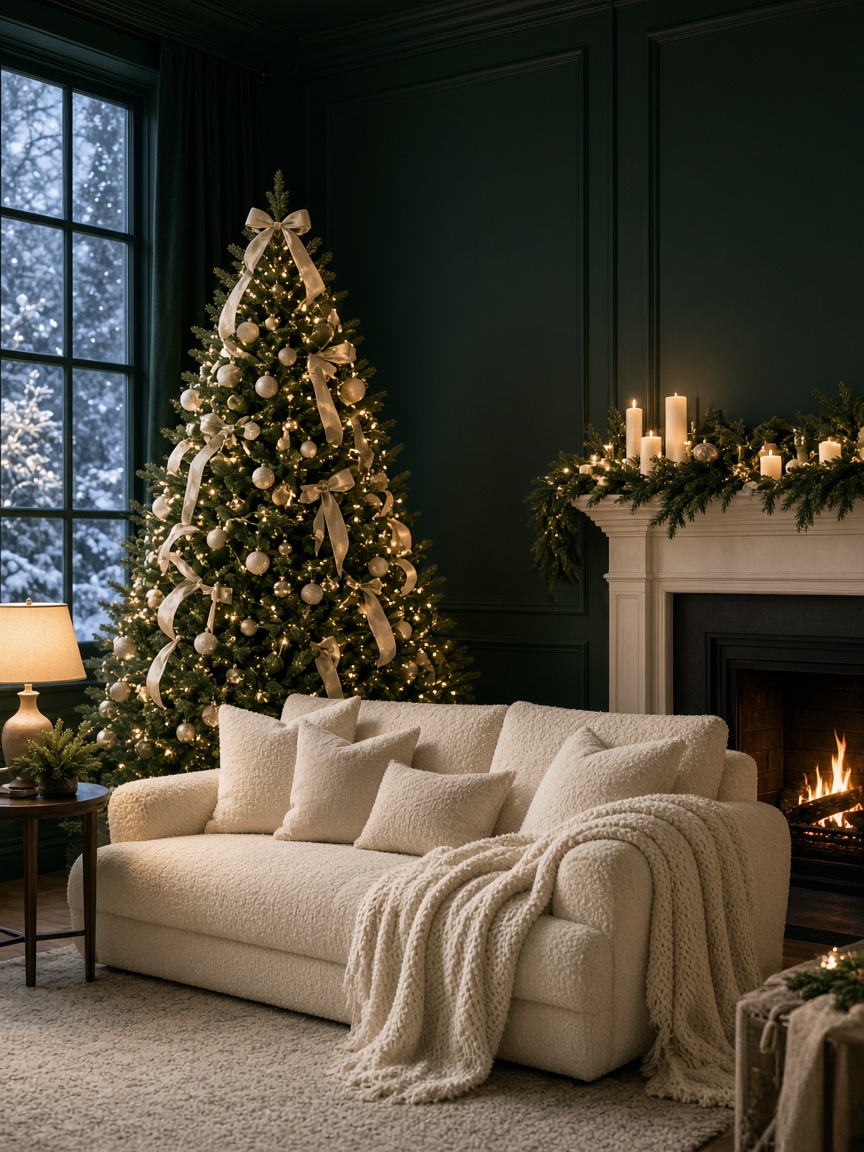
A Christmas house looks calmer when the colours agree with one another, even if the rooms are full. A palette is not a rule for every object. It is a short list you can hold in your head while you open boxes, so the tree, the table and the sofa cushions feel related.
You can borrow a scheme, test it in one room and then decide whether the rest of the house should follow.
The Christmas Decor Planner from Green Velvet helps you pick a minimal or maximal look, plan each room, and list only what you still need.
Start with what is already in the room
Paint and sofas do not change for December, so let them vote first.
- Look at the largest pieces: the sofa, the rug, the curtains, the wood tone of the table.
- Name two colours you already like in that room, plus one metal if you use metal at all, such as brass, black or silver.
- Open one box of ornaments and see which ones already sit well with those colours.
- Set aside the ornaments that fight the room. They can live on a kids’ tree, in a bowl in another room or in a box for another year.
- Take a photo in daylight and again after dark, because gold and red change under warm lamps.
If you chose a fall palette earlier and still like it, you can carry rust, olive and cream into Christmas with greenery and one deeper red or plum. Our fall colour palette for the living room is a useful reference for that hand-off.
Six schemes to borrow
These are starting points, not prescriptions. Swap one colour if your room asks for it.
- Cream, forest green and wood: quiet, natural and easy to live with. Add a single brass candle holder if the room needs a little light in the metal.
- White, silver and glass: crisp and wintry. Keep textures soft, such as wool and felt, so the room does not feel cold.
- Red, green and gold: the classic full look. It works best when one of the three leads and the other two support it, rather than when all three shout at the same volume.
- Plum, teal and gold: rich and a little unexpected. This one loves velvet, patterned ribbon and a layered tree. It is a natural cousin of our maximalist Christmas decor approach.
- Rust, cream and olive: a warm continuation of autumn, good if your tree is going up while fall throws are still out.
- Black, white and evergreen: graphic and modern. A black ribbon on a wreath, white lights and a lot of greenery will do most of the work.
If you prefer a quieter house, two colours and one natural material are enough. That is the spirit of our minimalist Christmas decor ideas.
How to test a palette in an evening
- Clear a coffee table or a section of the floor.
- Lay out a cloth or a scarf in the background colour.
- Add five to eight objects: an ornament, a ribbon, a candle, a pillow, a piece of greenery and one metal object.
- Remove anything you would not want to see twice in the room.
- Carry the group to the tree corner, then to the table, and see whether it still holds.
- Write the list on a card and tape it to the decor box, so the next session starts from a decision rather than a guess.
This little still life is more useful than buying a new set of ornaments and hoping they will settle in.
Keep the tree, mantel and table in the same family
They do not have to match. They do have to look as if they were invited to the same evening.
- Repeat one colour in all three places, even if it is only a ribbon or a few ornaments.
- Repeat one material, such as wood, glass or brass.
- Let one surface lead. If the tree is very full, let the table be simpler, or the other way around.
- Use the same lights throughout, ideally warm white, unless a single kids’ tree is meant to be the colourful exception.
- Step into the doorway and look at all three at once. If one area looks as if it belongs to a different house, edit that area, not the whole room.
Our guides to layered Christmas tree themes and Christmas table decor go deeper on those two surfaces once the colours are set.
When a room wants two palettes
Some houses have a quiet living room and a playful den, or a calm adult tree and a children’s tree that collects every handmade ornament.
- Give each palette a room, and close the door in your mind as well as in the plan.
- Use the hall as a bridge: greenery and one shared metal, without trying to mix both palettes there.
- Keep wrapping paper in one of the two schemes, or in kraft paper that sits beside both.
- Do not split a single tree down the middle unless it is a joke you will enjoy every time you look at it.
Shopping with a palette, and stopping
- Bring a photo of your still life when you go out, or keep it on your phone.
- Buy only the gap: the ribbon you do not have, the candles that match, the one box of ornaments that fills a hole.
- Beware of sets that introduce a fourth and fifth colour you did not plan.
- If you love a stray object, put it in a bowl in a private room or give it to the kids’ tree, rather than letting it rewrite the living room.
A written gap list is dull in the best way. It saves you from a second red that does not match the first.
Materials that help a palette hold together
- Ribbon is the fastest way to repeat a colour on the tree, the wreath and a stack of gifts.
- Candlelight, real in sturdy holders or flameless near greenery, warms every scheme.
- Paper, wool and wood soften a palette that would otherwise feel sharp.
- Pattern can belong in a maximal scheme if the colours inside the pattern already sit on your list.
- Clear glass does not add a colour, which makes it useful when the room is already full.
Wrapping, cards and the same scheme
Gifts and cards sit in the room for weeks, so they count as decor whether you mean them to or not.
- Choose one paper, or kraft paper plus one ribbon colour from the palette.
- Stack wrapped gifts under the tree or on a bench in a tidy pile, rather than scattering them on every surface.
- Stand cards on a single string or in a single bowl, in a place you already look at, such as a bookshelf.
- If a bag or a printed paper arrives in a clashing colour, set it in a bedroom until it is time to give it, or cover the clash with your ribbon.
This is a quiet way to keep the palette intact once December gets busy.
Less or More: palettes
| Less | More | |
|---|---|---|
| Two colours and one material | Three colours, one metal and a pattern | |
| Tree | Lights and ornaments in the two colours | Layers of ribbon, picks and mixed ornaments in the same family |
| Table | A runner and greenery | A runner, layered dishes and a repeating ribbon |
| Exceptions | One small kids’ tree | A second room with its own scheme |
| Watch out for | A room that feels pale or unfinished | A fourth colour creeping in from a sale bin |
Put the palette on paper
The Christmas Decor Planner: Minimal or Maximal from Green Velvet has a palette picker with three minimal and three maximal schemes, a room by room plan so the entry and the bedroom can follow the living room, and a gap and budget list that says to buy only what the plan is missing.
If you want a fuller house
Once the colours are chosen, the rest of the decorating goes faster. The Maximalism hub has more ideas for living with colour and pattern, and you can still keep one room quieter if that is how you like to sleep.
Free checklist: Less or More?
Not sure which lane fits your room or closet? Our free 2-page printable walks you through a one-hour room reset and a weekend closet sort, with a Less column, a More column and a stop rule for each. We will email it to you, free.


Leave a Reply