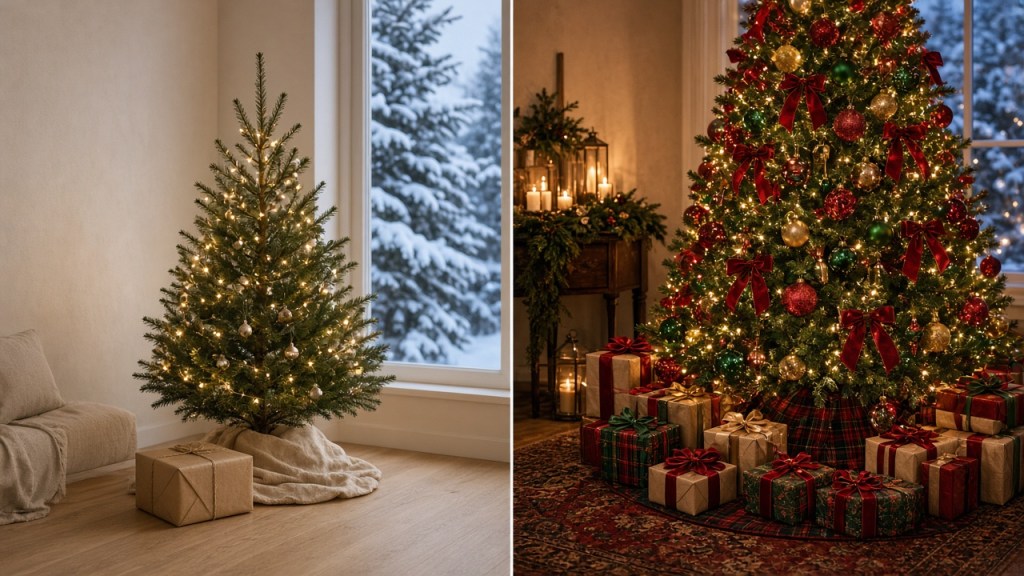
A Christmas tree is the largest object you will add to the room, so the choice between a real one and a faux one is worth making on purpose. Both can look beautiful. They ask different things of you: water and needles on one side, storage and fluffing on the other.
Walk the room, then choose the tree that will actually live well there, not the tree you liked in a photo.
The Christmas Decor Planner from Green Velvet helps you pick a minimal or maximal look, plan each room, and list only what you still need.
What the room can take
- Measure height and width the way you would for a small-space tree, and leave air above the topper and a path past the stand. Our small-space Christmas tree ideas cover the tape-on-the-floor test if the room is tight.
- Find the outlet before you fall in love with a corner, so the cord does not cross a walkway.
- Check the ceiling, the soffit and any pendant light.
- Think about heat: a radiator, a fireplace, a heat vent or a sunny window will dry a real tree quickly and is a poor neighbour for any tree.
- If you live in a rental or a building with a lift, plan the route in and out, including the stand and any water tray. Our renter-friendly Christmas decor guide has more on building rules.
A slightly smaller tree that sits cleanly will look more generous than a larger one you have to squeeze past every day.
A real tree: the case for it
- The scent is the reason many households still choose a cut tree, and it is hard to copy well.
- The look is irregular in a good way: branches that are not all the same length, a colour that is truly green.
- It is a seasonal object. When it leaves, the room returns to itself, which some people prefer to a box in the closet.
- A potted living tree can, in some cases, go back outside after the holidays if you have the right climate, a place to keep it and a plan to care for it. That is a different project from a cut tree, and it needs research before you buy.
A real tree also has a clock. It drinks, it dries, and it needs a leaving date.
Care for a cut tree
- Make a fresh cut at the base if the seller has not just done so, and get the trunk into water as soon as you can.
- Use a stand that holds water, and fill it every day. A dry stand is the usual reason a tree drops early.
- Keep it away from heat and from any real flame.
- Sweep or vacuum underneath often, and keep a cloth for the path in from the door, especially in a small home.
- Follow the manufacturer’s instructions for lights, and turn them off when you leave or go to bed.
- When the tree dries, take it out. Follow your municipality’s advice for pickup or drop-off, and do not leave a dry tree in the house.
If anyone in the house is very sensitive to scent or to sap, a real tree may not be the kindest choice, even if you love the idea of one.
A faux tree: the case for it
- You can set it up on a quiet evening and take it down on a date you already chose, without watching the water.
- It can be used again, which matters if storage is something you already have.
- A slim or sectioned tree is often easier in an apartment than a wide cut tree in a heavy stand.
- The look can be excellent if you fluff the branches, use warm lights and decorate with a firm palette.
- There is no needle drop on a wool rug, which is a real gift in a small living room.
A faux tree is only as good as the fluffing and the lights. A compressed tree pulled from a box and left half-flat will never look like the one in your mind.
Care for a faux tree
- Fluff from the inside out, working around the tree, rather than only dressing the tips.
- Use lights made for this kind of tree, and follow the manufacturer’s instructions. If the tree has lights built in, check them before you decorate.
- Choose a palette and stay with it, so a few ornaments look like a set. Our Christmas colour palette ideas will help if you have not chosen one yet.
- Pack it in a labelled bag or box when the season ends, with the topper and a note about which room it lived in.
- Store it somewhere dry, and do not crush it under heavier boxes.
If you already own a faux tree you do not like, try better lights and a tighter set of ornaments before you replace it. Many tired trees are really tired decorating.
Look, not just type
The real-versus-faux question is often a look question in disguise.
- A real tree with lights only can be as quiet as a minimal faux tree.
- A faux tree with ribbon, picks and a full set of ornaments can be as rich as any cut tree. That is the layered approach in our Christmas tree theme ideas and in our maximalist Christmas decor guide.
- A branch in a vase is a third option, and it suits a very small room or a second space, as in our minimalist Christmas decor ideas.
Choose the silhouette and the amount of decoration, then choose the materials that will support them.
Pets, children and safety
- Secure the stand so a pet or a toddler cannot tip the tree.
- Place breakable ornaments above reach, and use unbreakable ones on the lower branches.
- Keep water in a covered stand if you have a pet who might drink from it, and check plants and needles with your vet if you are unsure.
- Do not block a heater, a doorway or a fire escape route.
- Cords belong along the wall, never across a path.
Cost, time and the honest trade
You do not need a price to compare the work.
- A cut tree asks for a trip to buy it, a stand, daily water and a plan for disposal. The work is front-loaded each year.
- A faux tree asks for a longer first setup, then a shorter one in later years, plus a place to store it that will not crush the branches.
- Time on the calendar matters as much as money. If December is already full, a faux tree or a branch in a vase may be the kinder choice this year, even if you love a cut tree in principle.
- If you already own a decent faux tree, use it. A new cut tree on top of a tree in the closet is how rooms get crowded.
Neighbours, buildings and shared space
- Ask about building rules before you drag a wide cut tree through a lobby. Some buildings have dates, or prefer trees in bags.
- A needle trail in a shared hall is easy to avoid with a wrap and a cloth, and it is worth the two minutes.
- Balcony trees are only a good idea with a heavy pot, a wind plan and permission. Indoor trees should stay indoors.
Less or More: the tree you choose
| Less | More | |
|---|---|---|
| A smaller tree, lights and a handful of ornaments | A fuller tree, ribbon, layers of ornaments and a decided topper | |
| Real | A modest cut tree, watered daily, lights only or nearly only | A larger cut tree, well watered, dressed in a full palette |
| Faux | A slim tree, fluffed, with warm lights | A full faux tree, fluffed, with ribbon and a complete set of ornaments |
| Watch out for | A tree so small you forget it | A tree that dries out, or a faux tree left unfluffed in a walkway |
Put the tree on paper first
The Christmas Decor Planner: Minimal or Maximal from Green Velvet has a tree plan with three layers for a minimal tree and five for a maximal one, an ornament count and a gap list, and a lights and power plan so you know where the tree will plug in before you bring it home.
After you decide
Once the type is chosen, the rest is placement, lights and edit. Live with the bare or nearly bare tree for an evening before you add every ornament. The Minimalism hub has more ideas if you want the quieter version of either tree to still feel finished.
Free checklist: Less or More?
Not sure which lane fits your room or closet? Our free 2-page printable walks you through a one-hour room reset and a weekend closet sort, with a Less column, a More column and a stop rule for each. We will email it to you, free.


Leave a Reply